

Refractory Brick
Professional team
After more than 20 years of development and experience accumulation. Our union has strong research and development capability, R&D centre is full responsible for test, research and product innovation, with 31 senior engineers, 96 engineers and 179 assistant engineers.
Complete range of products
We produce and operate refractory raw materials, refractory products, ceramic products, graphite electrodes, refractory binders, wear-resistant, acid-resistant and heat-resistant products, special building materials, silicon carbide products, refractory equipment, molds, copper molds, copper tubes, copper plates, Stainless steel products, slag pot, etc., including import and export. Imported calcium stabilized zirconia, yttria stabilized zirconia, quartz sand, graphite, andalusite, zirconium corundum etc.
High quality service
Zibo runjin has been persisting in a service philosophy of "Customers's Satisfaction is our eternal pursuit", taken "building a Worldwide first -class refractory manufactures" as the mission, and held "co-creation, co-operation, co-prograss, win-win"as its core values.Relying on management and technology accumulation during past many years, based on its over many years reputation as guarantee. Zibo runjin is doing its best to offer refractory system solutions with values added to achieve co-progress with our customers.
Advanced equipment
There are five high-quality clay high alumina brick production lines, two production lines for andalusite brick and mullite brick, five silica brick production lines, three production lines for continuous casting, One carbon and silicon carbide composite refractory production line ,One production line for tundish stabilizer, impact plate and slag retaining wall, a production line for high-grade light products, Pure oxide refractory production line, Unshaped refractory production line, Non-fired brick refractory product production line.
What Are Refractory Bricks
Bricks are the most significant construction materials. Mankind has been using them for thousands of years. But when it comes to withstanding high temperatures, normal bricks cannot serve the purpose. As conventional bricks always tend to crack at high temperatures, they are replaced by refractory bricks. Refractory bricks are special types of bricks well-known for their unmatched ability to combat high temperatures. Some of the other names of these bricks are ceramic bricks or fire bricks.
-
 Checker Brick For Coke OvenFire clay bricks for coke ovens are made of clay and sintered at high temperature to form a porousAdd to Inquiry
 -
 Acid Resistant Bricks1. It has excellent chemical stability, strong acid resistance, and also has a certain degree ofAdd to Inquiry
 -
 High Alumina BricksHigh alumina brick is a neutral refractory material with an alumina content of more than 48%. It isAdd to Inquiry
 -
 Pouring BricksPouring bricks are hollow refractory bricks built in the grooves of the bottom plate for ingots toAdd to Inquiry
 -
 Coke Oven Dry Quenching BricksThese products possess excellent property of spalling resistance and abrasion resistance. TheAdd to Inquiry
 -
 Electric Furnace Top BrickElectric furnace roof high alumina bricks refer to refractory products for electric furnace roofsAdd to Inquiry
 -
 Refractory for Cement KilnHigh-alumina bricks suitable for cement kilns mainly include phosphate-bonded high-alumina bricks,Add to Inquiry
 -
 Corundum BricksCorundum bricks refer to refractory products with alumina content greater than 90% and corundum asAdd to Inquiry


- Tel: +86-13606432571
- Fax: +86-533-2882161
- Email: cyhu@163169.net
- Add: NO.188 Huaguang Road, Zhangdian, Zibo, Shandong, China Yulong Building B1401
Refractory Brick vs Fire Brick: Key Differences
While both refractory bricks and fire bricks are designed for high-temperature applications, there are some critical differences that make them suitable for different purposes:
Composition
Refractory bricks, including SiC refractory bricks, are typically made from materials like silicon carbide, alumina, zirconia or are containing a higher amount of mullite. Fire bricks, on the other hand, are primarily composed of clay minerals and alumina or mullite in lower quantities.
Thermal properties
Refractory bricks generally have a higher thermal conductivity as of their higher density.
Application-specific performance
Refractory bricks are designed for specific high-temperature applications and environments, offering better performance in terms of wear, corrosion because of direct contact with the corrosive media, and thermal resistance. Fire bricks, while suitable for general high-temperature applications, may not perform as well in more demanding environments and have a limited maximum temperature of use.
Cost
Due to their high quality raw materials and properties, cost of refractory bricks is typically premium compared to fire bricks.
The use of refractory bricks has a lot of benefits. They are more expensive than traditional bricks due to their exceptional high-end insulating power. For your further investments, they do offer some unique gifts.
Outstanding insulation
Fire bricks are mainly used for their excellent insulating properties. They can prevent heat from passing through them. They also maintain the building's comfort in summer and winter.
Superior strength bricks
Refractory bricks are more durable than regular bricks. They are hence more resilient than traditional bricks. They are also relatively light.
Any size and shape
We offer customers personalized bricks in specified shapes and dimensions.

The secret to wood ovens comes in the form of refractory bricks. These bricks are made from a special type of ceramic which can withstand high temperatures without damage. A typical brick could start to break apart at 1200 degrees Fahrenheit (~ 649 degrees Celsius), but a refractory brick will handle heat up to 1800 degrees Fahrenheit (~982 degrees Celsius). This removes any of the stress that may come from heating up the wood oven, and you'll be able to safely turn the temperature up knowing that the bricks can handle the heat.
Refractory bricks are also energy efficient. This is because refractory bricks have low thermal conductivity, meaning that they start absorbing the heat quickly, so there's no waste when preparing your meal. The bricks coupled with convection design, quality stainless steel, and outstanding ventilation allow to retain heat for your perfect cook.
Not only are refractory bricks tough against the heat, but they can also handle the wear-and-tear of cooking. You don't have to worry about delicately touching your tools to the surface of an oven with refractory bricks. They are sturdy and resistance to abrasion – not only durable but long lasting.
Refractory bricks often line the walls of industrial furnaces and incinerators, so you know they can take the heat and you can focus on cooking the perfect pizza or meal.
● The water absorption of a refractory brick is 5 to 10%.
● They have a high fusion point.
● Refractory bricks resist high temperatures.
● They have outstanding compressive strength.
● The weight of fire bricks is 150 lbs per cubic ft.
● The size of a refractory brick is 9×4.5×2.5 inches or 9×2.7×2.25 inches.
● Refractory bricks also have unmatched chemical resistance
● They also do not react with the gases of the furnace.
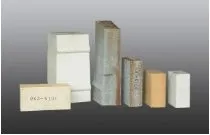
Refractory brick is frequently used to construct kilns, furnaces and other high-temperature enclosures. That's because refractory brick reduces heat loss and the chance of an unintended fire.
The composition of the refractory brick will determine what temperatures it can withstand. Some types of refractory brick can withstand temperatures of over 2,100 degrees Celsius (3,600 degrees Fahrenheit). However, bricks heated above these temperatures will typically begin to melt.
Refractory brick is formed by a variety of brick-making processes—for example, soft-mud casting, hot pressing and dry pressing. Depending on the material of the refractory brick, some processes will work better than others. Refractory brick is typically formed into rectangular shapes measuring nine inches long by four inches wide (22.8 centimetres by 10.1 centimetres) and a between one and three inches thick (2.5 centimetres to 7.6 centimetres).
Corrosion reactions proceed in the direction of localized chemical equilibrium. Essentially, corrosion reactions are what happens when the system trying to achieve compatibility and attempts to do this by progressing toward equilibrium. Refractories, generally, are rarely at chemical equilibrium because they are typically made from a mixture of different minerals. Although at an immediate corrosion interface that may exist between the refractory and the slag, the localized volume elements tends to be at or close to chemical equilibrium. The reactive component in the phenomenon that occurs during refractory corrosion is called the "slag".
The matrix is the area of sintered fines that holds bonded bricks and monolithic refractories together. Corrosion usually affects the weakest component of the refractory at a higher rate than denser or higher purity particles that may be in the area and acts faster in such areas. In extreme cases of a matrix attack, there is rapid erosion of refractory aggregate that at times occurs.
Grades Are Important: Refractory Brick
The main ingredient in fire bricks is fireclay, which contains mostly alumina and silica, elements capable of withstanding high temperatures. Hard bricks are available in several grades, depending on their composition and properties, which determine the most efficient use of them in construction. High alumina compositions start at 50% alumina and increase in alumina content to 98% for the highest purity and most expensive. It's extremely rare that a potter would require an alumina content exceeding 70%.
Low-duty: Typically rated to 1750°F maximum service temperature. Primarily used for fireplace chimneys and contains 24–26% alumina.
Medium duty: Temperature rating to 2700°F maximum service temperature. Uses include backup linings, lower-temperature ceramic kilns and chimneys, and contains 34–38% alumina.
High Duty (first-quality firebrick): Temperature rating to 2850°F maximum in purely heat service. Certain atmospheres can reduce this temperature rating by several hundred degrees and contains 36–40% alumina. Uses include boilers, ceramic kilns, chimneys and back-up linings.
Super Duty: Temperature rating to 2900°F in pure heat service. Certain atmospheres can reduce this temperature rating by several hundred degrees. Same uses as high duty where higher temperatures are involved. Contains 40–44% alumina.
High-Fired Super Duty: Temperature rating between 3000°F–3150°F. A higher burned version of super duty firebrick designed to lower the porosity, increase physical strength and improve resistance to alkali attack and carbon monoxide disintegration. Contains 40–44% alumina.
Application Scenarios of Refractory Bricks
Iron and Steel Industry
The iron and steel industry is the primary consumer of refractory bricks. Blast furnaces, converters, and ladles require refractory bricks to withstand the high-temperature environment. Refractory bricks are also used in coke ovens, sintering machines, and hot blast stoves.
Glass Industry
The glass industry uses refractory bricks in its melting furnaces, where temperatures can reach up to 1600°C. Refractory bricks help maintain the required temperature and protect the underlying structure from heat damage.
Cement Industry
In the cement industry, refractory bricks are used in rotary kilns, preheaters, and coolers. These fire-resistant bricks provide insulation and protect the kiln from the high-temperature environment.
Petrochemical Industry
The petrochemical industry uses refractory bricks in reactors, reformers, and crackers. These bricks provide thermal insulation and protect the equipment from high-temperature and corrosive environments.
Our Factory
After more than 20 years of development and experience accumulation, The main production plants of Runjin technology and trade complex are as follows:
Qingdao Huaye New Material co., ltd.
Shandong Daqiao New Material co., Ltd.
Yangquan Wanglong Refarctories co.Ltd.
Anshan Aoan High Temperature Material Co., Ltd.
It's total assets value has reached 1.05 Billion RMB and currently employs 4078 personnel, including 544 refractory technical personnel and 3145 well trained workers
The annual production capacity has exceeded 30 thousands tons with comprehensive seven series refractories as following: Fire clay bricks, Alumina bricks, Con-casting refractory, Binder for refractory, Fine Ceramics, Graphite electrode, acid resistant brick, Silicon carbon crucible, Silicon carbon plate, Special building material, Cellulose ether, Super chamotte raw material and Synthesized mullite material, Magnesia raw material, etc. Products are applied to worldwide industries of metallurgy, building material, non-ferrous metal smelting, petrochemical, nonferrous, electronics, cement industry and so on. Approx. 68% products are supplied to metallurgy industry. China leading Steel group.-e.g.Baowu steel, Anshan steel, WISCO, SHOUGANG, TISCO, PANGANG, HBIS, SHAGANG, which belongs to same parent company are our main customers in domestic market.in oversea market, Zibo runjin is a refractory supplied of Arcelor - mittal, POSCO Guangyang steel, HYUNDAI steel, Nippon steel, JFE steel, US United Steel, Erdemir group., Danieli, SVAI and working together with famous refractory manufactures -e.g.Chosun refractories, ANH refractories and Krosaki refractories etc. Zibo runjin also has a good cooperation with world famous engineering companies .
our union has strong research and development capability, R&D centre is full responsible for test, research and product innovation, with 31 senior engineers, 96 engineers and 179 assistant engineers. Zibo runjin enables itself to be one of then leading refractory manufactures for supplying andalusite bricks for CDQ furnace, silicon bricks, AG con-casting refractory and so.
Zibo runjin has been persisting in a service philosophy of "Customers's Satisfaction is our eternal pursuit", taken "building a Worldwide first -class refractory manufactures" as the mission, and held "co-creation, co-operation, co-prograss, win-win"as its core values.Relying on management and technology accumulation during past many years, based on its over many years reputation as guarantee. Zibo runjin is doing its best to offer refractory system solutions with values added to achieve co-progress with our customers.

FAQ
As one of the leading refractory brick suppliers in China, we warmly welcome you to buy or wholesale high-grade refractory brick in stock here from our factory. All our products are with high quality and competitive price.
pure corundum brick, Sillimanite brick, Corundum shaped parts